Transform Your Staff Meetings into Productive Time










nyone who has ever been part of a team knows that staff meetings can be monotonous. Even with an ongoing agenda of topics, staff meetings are dry, repetitive, and non-productive. While routine staff meetings keep your team informed, many of them lack purpose and feel like wasted time for everyone.
In this article, we provide you with guidelines on how to add more energy to your staff meetings by engaging your team in ongoing problem-solving and process improvement activity. By using time in each staff meeting to diagnose and solve problems, you will not only become a more effective leader, but this allows you to adopt an easy and proactive process improvement methodology that benefits your team and the organization.
Note: It does not matter if your meetings are live and in-person, or virtual, you can vary how you facilitate these ideas based on the communication method.
If you decide to implement this process in your meetings, it’s a good idea in your first staff meeting to share your intent with the team. Explain that in order to use their time more effectively, you want to dedicate time in each meeting to address current problems, improve internal or externals processes, procedures, or how you do business. Add an agenda item (suggested 30 minutes) to focus on problem-solving/process improvement. Solicit and address concerns or questions from your team members.
Once you have established that process improvement will be a standard for your staff meetings, it’s important to get the team’s input on what should be addressed. Use another staff meeting to conduct a brainstorming session with the team to identify the ideas to focus on in subsequent meetings.
If your team has generated a long list of ideas, you will want to identify which ones are most useful to focus on in subsequent meetings. Identify criteria (with the team’s input) to help you determine which ideas to work on as a team. Some examples of criteria to use may include customer impacts, cost reduction, scope of problem, and impact to the organization and people. Make sure to get everyone’s input and gain agreement from the team for the priorities that you will address moving forward in future team meetings.
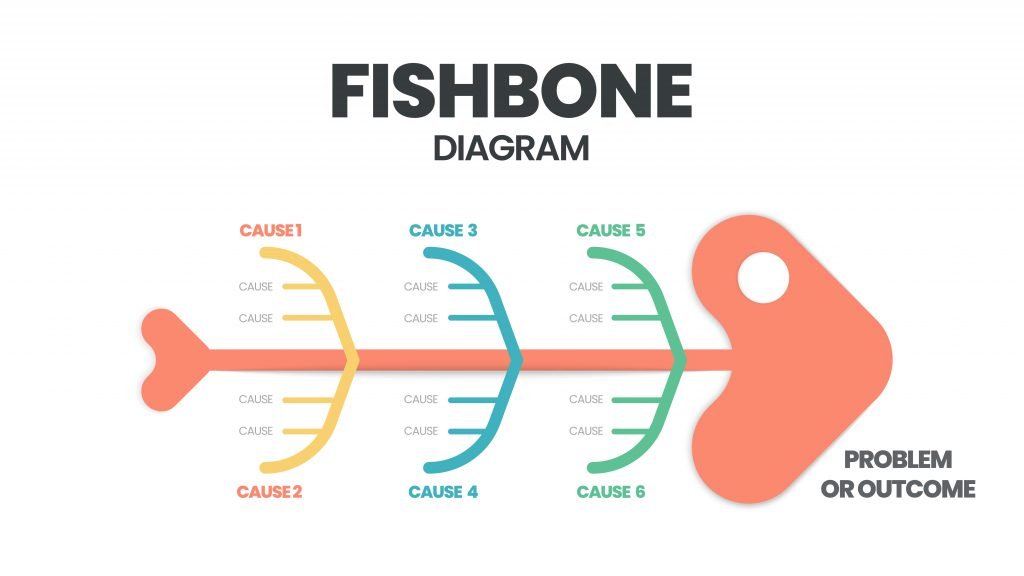
One way to analyze the identified problem is through the use of a useful problem-solving tool – the Ishikawa Diagram. The Ishikawa Diagram, or more commonly referred to as the Fishbone Diagram, is a process that considers the cause and effect of a problem to help get to the root cause (see example below).
Starting with the problem statement, brainstorm possible cause/effect of the problem to pinpoint what may be at the root of the problem. In most cases, the Fishbone process demonstrates the complexity of any issue, and provides you with multiple ways of looking at the problem. After the initial brainstorming, your team may combine some or throw out others to come up with the single most important driver of your identified problem.
Once you have identified the possible causes of a problem, now you can generate ideas on how to solve it. Use the brainstorming process and process of elimination to arrive at solutions that your team members can implement. Make sure to establish criteria for evaluating the implemented solution.
If you have taken a problem through this process, it’s time to implement your chosen solution. Assign the solution to a member or members of your team. Ask for a plan that outlines the steps, milestones, due dates, and responsibility of each task. Use subsequent meetings to have team members report on the progress and outcomes of the solution.
Congratulations! You have taken your team through the creative process for identifying and designing solutions to improve your business. Continue this process with other ideas generated from your initial brainstorming session with the team.
If you want to be a more effective leader and increase the engagement of your team, implementing a simple process improvement approach to your staff meetings can make a big difference.
About WestStar Associates
We are practitioners of proven change leadership concepts with emphasis on reinforcement and measurement of change efforts. We are a strategic solution provider utilizing all methods of learning, performance support, and leadership practices to enable and sustain organizational and employee growth.
Our guiding principles are:

From strategic concept to delivery, we enable your organization and people to thrive during times of transformation.
Our Learning and Development Solutions Get Results
We are honored to have received the Brandon Hall HCM Excellence Award three years in a row for our design and development efforts on a senior leadership development program in partnership with Synovus Financial Services and TrainingPros.